What are flowers symbolic of? Beauty? Peace?
In literature or poetry or art maybe so, but in everyday life in London I suppose they are those things that you are more likely to see in decorative forms in shop windows, or pieces of design on a dress that that girl over there is wearing, or perhaps if you're lucky enough you may pass some spots of colour that line your zone 3 street.
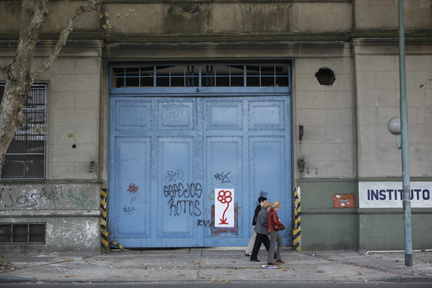
Michael De Feo had fashioned a form of identity out of a flower. It is a sign that has become synonymous with his art. He has left them as signatures in various cities all over the world. It's a beautifully simple depiction of a flower that has five petals and a stem with a slight kink. It's a signature to be envious of.
For someone who was holding his first solo exhibition in London, an overdue occasion for an artist who has been daubing the streets with his work for eighteen years, I wonder if he was pleased with the outcome. The Orange Dot gallery is a small creative space found in Tavistock Place, a somewhat unlikely location considering these sorts of places are more commonly found further east. Russell Square is not an area associated with artists or a necessarily established artistic identity, but the gallery seems at home on the small parade of shops where it lives. I visited when it first opened last summer (back when this blog was new and I was enthusiastic and envisaged making entries daily) and what was then a project now seems to have transformed into a professional place to exhibit work.
I was hoping to see more of De Feo's brooding, battle-scarred portraits. The ones where the paint is dripping, the features ignored, and the mood is bleak. Instead the left hand wall of the room was lined with his flowers. Most were an edition of a series, the rest of them presumably being elsewhere, made using differing printing techniques and materials. The space is small though, and there is only so many times you can survey a wall of 8 hanging flowers and feel drawn. The costs of each piece varied wildly, with one on the facing wall costing almost double if sold framed. There was a single abstract portrait, of the series where he used maps as the canvas, and another self portrait towards the back of the room where the two girls were serving beers into plastic cups.
Was it more of a sales show? Most pieces had prices, with a couple having the obligatory 'sold' signs next to them. I stood around in the small space, looking for a friendly face to talk to. The one fraught looking guy I did have a brief chat to was a sculptor, and even he asked me if I was going to buy anything. The other people who filled the room were tall and edgy, who seemed to look at each rather than the work on the walls. After spending around half an hour in there I couldn't shake the feeling of being in a hip youth club where anyone was allowed on the decks as long as they played early 90s hip hop. Let's face it this is what many of these sorts of shows entail; standing and talking, looking and snapping on one's SLR. The art is secondary and that is not unusual. The frustrating thing was it was a combination of an oblivious collection of people, not the best of De Feo's work on show, and most importantly not enough of it. The Orange Dot is more than just a gallery and it's always good to see small organisations acting progressively and getting people involved. The gallery is a great little space that could be used in a range of ways, but it was one of those evenings that the work on show felt a little neglected.
Looking forward to seeing what comes next
Michael De Feo: Coming In From The Outside
www.orangedotgallery.co.uk
54 Tavistock Place, London WC1H 9RG
Thursday, 10 March 2011
Tuesday, 10 August 2010
Subtlemob
This is a brilliant idea and one with huge commercial potential. It is an 'invisible' movement and one that would have to be artistically respected but the possibilities are almost endless. Subtlemob is essentially a silent movie where you can get involved as part of the set anonymously. By downloading an mp3 to your phone or ipod prior to the event you are given instructions to meet at a certain place within an urban environment and then await further direction
'Audiences were invited to download an MP3 and turn up at a secret location to listen to the track at a specified time.
On the soundtrack the audience would hear the composed soundtrack along with narration and instructions.
Two MP3 files were made available, so the audience were divided in half. While one group was instructed to perform a simple scene the other group heard this described as if it were a film scene, but they could actually see it happening around them.
Throughout the piece these roles of watcher/performer alternated between the groups, ever increasing in pace until by the end they are all performing/watching simultaneously.
The work was a snapshot image of contemporary Britain, allowing the audience to watch it, reflect on it, and live it. It explored ideas of how mobile technology can create social disconnection in shared public spaces. It also looked for ways to use those same technologies to create connections between strangers and friends, to savour the moment and the temporary space that was created during the performance'.
From the project description…
“When you put on the headphones you’ll find yourself immersed in the cinema of everyday life. As the soundtrack swells people in the crowd around you will begin to re-enact the England of today.
Sometimes you’ll just be drifting and watching, but sometimes you’ll be following instructions or creating the scenes yourself. Don’t worry, there will be nothing illegal or embarrassing, sometimes you might be re-enacting moments you’ve seen in films, sometimes you’ll just be playing yourself.
This is no requiem, this a celebratory slow dance, a chance to savour the world you live in, and to see it with fresh eyes.”
'Audiences were invited to download an MP3 and turn up at a secret location to listen to the track at a specified time.
On the soundtrack the audience would hear the composed soundtrack along with narration and instructions.
Two MP3 files were made available, so the audience were divided in half. While one group was instructed to perform a simple scene the other group heard this described as if it were a film scene, but they could actually see it happening around them.
Throughout the piece these roles of watcher/performer alternated between the groups, ever increasing in pace until by the end they are all performing/watching simultaneously.
The work was a snapshot image of contemporary Britain, allowing the audience to watch it, reflect on it, and live it. It explored ideas of how mobile technology can create social disconnection in shared public spaces. It also looked for ways to use those same technologies to create connections between strangers and friends, to savour the moment and the temporary space that was created during the performance'.
From the project description…
“When you put on the headphones you’ll find yourself immersed in the cinema of everyday life. As the soundtrack swells people in the crowd around you will begin to re-enact the England of today.
Sometimes you’ll just be drifting and watching, but sometimes you’ll be following instructions or creating the scenes yourself. Don’t worry, there will be nothing illegal or embarrassing, sometimes you might be re-enacting moments you’ve seen in films, sometimes you’ll just be playing yourself.
This is no requiem, this a celebratory slow dance, a chance to savour the world you live in, and to see it with fresh eyes.”
Monday, 9 August 2010
Inspiration Pad
Friday, 6 August 2010
Reds vs the Greens
I came across this ages ago and this morning it seems to have surfaced in my mind again when I was thinking of something edgy and alternative to post. Originall an ad for Snickers (I think)It's not either really. But I still like it.
Monday, 12 July 2010
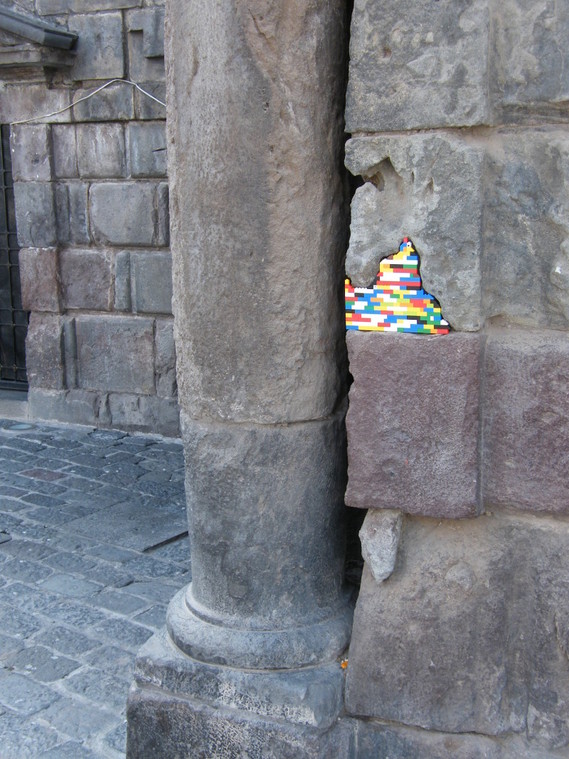
Dispatchwork
A beautifully innovative way of making breaking buildings look colourful with Lego
http://www.dispatchwork.info/


An infrequent reader of WIRED mag, it threw up this little gem. After some investigating this activity of Dispatchwork is taking place in various cities around the world. Could London be next?
http://www.dispatchwork.info/


An infrequent reader of WIRED mag, it threw up this little gem. After some investigating this activity of Dispatchwork is taking place in various cities around the world. Could London be next?
Wednesday, 30 June 2010
In The Company of Alice
I'm still not sure what to make of my first visit to the Gagosian last Saturday. I was looking forward to seeing some Picassos up close, as anyone usually is, but I was aware that the period the show was covering was a time I was quite unfamiliar with. He was getting on a bit, he was famous, he was spending time with his family in the sun and becoming ever more inventive, showing no signs of slowing down (I read in a review somewhere that he was making the equivalent of 3 works a day over the last 20 years of his life). These may seem like reasons to be cheerful and optimistic about seeing the show but with someone like Picasso I'm quite safe, in that I know what I like and I like to keep that fondness safely locked away. His ever constant production of painting after painting after ceramic after sculpture after paper cut-outs made me feel a bit lost. After a while I became a bit indifferent to the wealth of experimentation I was seeing around me.
There were some pieces I really liked. I liked the large self portrait of him swimming, albeit what looked like quite badly but I think that was a reason it gave it it's charm. The drawings of the bull displayed as if in sequence was great as it showed the thought that went behind the structure of his drawings. Pieces like these were a couple of the stand-outs for me in what was a fairly easy going show. One of the main things I won't forget is the surly looking guards (are they guards? Wardens? Assistants?) hovering around as if waiting for James Bond to run through the gallery so they could take him out. It wasn't conducive with a friendly vibe but then again perhaps they get happier, more approachable people in when the artist on show is not so famous.
Anyway, on to what I really wanted to mention. After we left the Gagosian my friend and I had a stroll in the Saturday sun up to another gallery in an area of north London I didn't know very well. Tucked away on Wharf Road near Angel you could easily miss it if you didn't know where to look. We rang on the buzzer of what seemed to be one of many new warehouse spaces. Buzz it went and we walked into quite a basic two floor space. The complete antithesis of the Gagosian, we walked in undisturbed, picked up the painting list and worked our way round. There was a chap behind a desk in a small room to the left as you walked in but apart from him and a woman in yellow shoes we were the only people in there.
There were portraits from artists of differing notoriety and age. Chris Ofili had a self portrait of him wearing an orange tee shirt, there was quite a cool portrait by Grayson Perry of him in his drag made of a shiny ceramic, like a kind of mosaic. The range of work there made it interesting and varied. The variation made it compelling. A piece by a guy (or girl?) called NS Harsha called Sky gazers was a collection of what must have been over a hundred faces looking up to the sky. Each person was different, but painted in such a way that they reminded me of the characters in an old copy of the Body Book I had when I was about 8. Basic black outlines and blocked in colours for their clothes. When you stood back and realised they were all looking up at you, as though you were this big person looking back at them from the sky was quite satisfying. Chantal Joffe was another who had a couple of portraits on show. The crude outlines and large-eyed characters in her work gave them an innocence which I really liked, and the unfinished feel of them gave the subjects a coarse reality. The splodgy marks of a nose, the wonky arms and strange mouths made them real, and I guess that's something which is quite important about portraiture - the ability to make the person you are painting real. I think if you make them seem human, with faults and mistakes, a likeness will come through. I can't seem to find the 2 pieces she had on show anywhere online (Stella, and Megan), but I have managed to find some other pictures that should give you an idea of what I'm talking about (see above post, I haven't managed to work out how to embed pics within the body of text yet).
At the top of the painting list was a quote by Gertrude Stein, "If you do not solve your painting problem in painting humans, you do not solve it at all". I'm pleased I went so I could see this range of people in portrait form. Loads of people working out what they are trying to portray, so I guess in the process of what Gertrude must have meant.
Subscribe to:
Posts (Atom)